Car, Tractor & Work Vehicles theory test
Cars, tractors and work vehicles.
40
questions45 minutes
to answer them35 of 40 (88%)
to passRoad signs
Learn the system, not just the pictures. Once you know what each shape and colour means you can read a sign you have never seen before — which is exactly what the test is checking. 70 signs can appear on the category BW test.
Shape and colour
Amber diamond
Warning — a hazard ahead. Ireland uses a diamond, not the red triangle used across most of Europe and in the UK.
Orange diamond
Warning at roadworks. Deliberately distinct from the permanent amber ones, so a temporary hazard stands out.
Red circle
Prohibition — you must not.
Blue circle
Mandatory — you must.
Octagon
Stop, and nothing else uses this shape.
Inverted triangle
Yield.
Blue rectangle
Information.
Red prohibits, blue compels. Getting that pair straight answers a large share of the sign questions on the test.
Direction signs
The colour tells you what class of road you are being sent onto — and therefore what its default speed limit is.
Blue
Motorway
Green
National roads (N-numbers)
White with black text
Regional and local roads
Brown
Tourist and heritage attractions
Information 7
Parking
Parking is available. Any conditions appear on a plate beneath.
Hospital
A hospital with an emergency department is ahead.
Services
Fuel, food or other services are available ahead.
Lay-by
A place to pull in and stop off the carriageway.
On a long drive this is where you take the 15-minute nap that actually treats fatigue.
Tourist attraction
A tourist or heritage destination is signed ahead.
Brown is reserved for tourism — castles, beaches, national parks.
National road direction sign
Directions along the national road network.
Green with white lettering. An N-route number in a blue box means the road upgrades to motorway further along.
Regional or local road direction sign
Directions along regional and local roads.
White with black lettering.
Motorway 6
Motorway begins
Motorway rules apply from this point.
Learner permit holders, pedestrians, cyclists, animals and vehicles under 50cc are all prohibited beyond this sign.
Motorway ends
Motorway rules no longer apply.
Countdown marker — 300 m
The exit slip road starts 300 metres ahead.
Each bar is 100 metres, counting down 300, 200, 100.
Motorway junction ahead
The next junction and its destinations.
Blue background means motorway. Green means national roads, white means regional and local, brown means tourist attractions.
Red X — lane closed
The lane below the red X is closed. Move out of it.
Usually an incident or workers ahead. Driving through a red X is an offence.
Emergency area
A refuge for breakdowns and emergencies only.
Regulatory 20
Stop
Come to a complete stop at the line and only move off when it is safe.
The octagon is used for nothing else, so it stays recognisable when dirty or partly hidden. A full stop is required every time, even on an empty road.
Yield
Give way to traffic on the road you are joining.
The inverted triangle with a red border. You need not stop if the way is genuinely clear, but you must be able to.
No entry
You may not drive past this sign in that direction.
A red circle with a white horizontal bar. It commonly marks the wrong end of a one-way street.
No overtaking
Overtaking is prohibited from this sign until it ends.
The prohibition runs until an end-of-restriction sign or, on most roads, the next junction.
No parking
You may not park here.
A red circle with a single diagonal bar. A plate beneath gives the times it applies.
No stopping (clearway)
You may not stop here, even briefly to set down a passenger.
Two crossed diagonal bars in a red circle. Stricter than no parking.
No U-turn
You may not turn back on yourself here.
No right turn
Turning right at this junction is prohibited.
No left turn
Turning left at this junction is prohibited.
No motor vehicles
All mechanically propelled vehicles are prohibited.
Typically a pedestrianised street or an amenity route.
No cycling
Cyclists may not use this road.
No pedestrians
Pedestrians may not use this road.
Found at motorway entrances and in tunnels.
Speed limit
The maximum speed in kilometres per hour for this stretch of road.
A maximum, never a target. You must still drive more slowly whenever conditions require it.
End of speed limit
The special limit ends and the default for this class of road applies again.
That default could be 50, 60, 80, 100 or 120 km/h depending on the road you are on.
Minimum speed
You must not travel below the speed shown.
A blue circle rather than a red one — this compels rather than prohibits.
Turn left ahead
You must turn left at the junction ahead.
Blue circles compel; red circles prohibit. Learning that pair answers a large share of the sign questions on the test.
Keep left
Pass to the left of the obstruction or island.
Roundabout
Traffic must travel clockwise around the island.
Bus lane
This lane is reserved for buses during the times shown.
Driving in an active bus lane is an offence, and the times are on a plate beneath the sign.
One-way traffic
Traffic on this road travels in one direction only.
Roadworks 5
Roadworks ahead
Works are in progress on the road ahead.
Roadworks signs are orange, deliberately different from the permanent amber warning signs, so a temporary hazard stands out.
Loose chippings
Loose stone chippings are on the surface — reduce speed to avoid throwing them up.
Traffic control ahead
A person is directing traffic through the works.
A Garda or an authorised traffic controller overrides every other sign and signal.
Lane closed ahead
The lane shown is closed — merge in turn before you reach the closure.
Diversion
Follow the diversion route shown.
Warning 32
Crossroads ahead
A crossroads is ahead.
Ireland uses an amber diamond for warnings, not the red triangle used across most of Europe and in the UK. The width of the arms tells you which road is the major one.
T-junction ahead
The road ahead ends at a T-junction.
Side road ahead
A road joins from the side ahead.
Roundabout ahead
A roundabout is ahead — be ready to yield to traffic from your right.
Yield ahead
You will have to give way at the junction ahead.
Advance warning, so you have time to slow and look before you reach the junction itself.
Stop ahead
You will have to stop at the junction ahead.
Traffic signals ahead
Traffic lights are ahead.
Often placed where the lights are hidden by a bend or a crest.
Merging traffic
Traffic joins from the side ahead and may merge with your lane.
Sharp bend to the left
A sharp left-hand bend is ahead.
Slow to a safe speed before the bend, not during it — braking mid-corner unsettles the vehicle and reduces grip.
Sharp bend to the right
A sharp right-hand bend is ahead.
Series of bends
Several bends follow, the first in the direction shown.
Road narrows
The carriageway narrows ahead, on the side shown.
Two-way traffic ahead
The road ahead carries traffic in both directions.
Common where a dual carriageway ends — a genuinely dangerous transition if it takes you by surprise.
Oncoming traffic has priority
Give way to traffic coming the other way through the narrow section.
The red arrow is your direction of travel.
Dual carriageway ends
The dual carriageway ends and the road becomes two-way.
Steep descent
A steep downhill gradient is ahead.
Select a lower gear so engine braking controls your speed. Continuous braking overheats the brakes and fades them away exactly when you need them.
Steep ascent
A steep uphill gradient is ahead.
Uneven road surface
The surface ahead is uneven or has bumps.
Slippery road
The surface ahead may be slippery.
Reduce speed early and avoid harsh braking or steering.
School children crossing
Children may be crossing, usually near a school.
Expect children to appear without warning and to misjudge speed and distance.
Pedestrian crossing ahead
A pedestrian crossing is ahead.
Cyclists
Cyclists may be crossing or joining the road ahead.
Look carefully — a cyclist is easy to miss against a cluttered background.
Cattle crossing
Farm animals may be on or crossing the road.
Slow right down, give a wide berth and never sound the horn.
Wild animals
Deer or other wild animals may cross the road.
Most active at dawn and dusk, and where one crosses others usually follow.
Horses and riders
Horses may be on the road.
Pass wide and slow. Horses startle easily, and revving or sounding the horn is how a rider ends up on the tarmac.
Level crossing with gates
A railway level crossing with gates or a barrier is ahead.
Level crossing without gates
An unprotected railway level crossing is ahead.
Tunnel ahead
A tunnel is ahead — remove sunglasses and switch on dipped headlights.
Side winds
Strong crosswinds are likely on this stretch.
Worst on bridges and exposed cuttings, and when emerging from behind a high-sided vehicle.
Falling rocks
Rocks or debris may be on the carriageway.
Ford or flooding
Water may cross or cover the road ahead.
Quay or river bank
The road runs alongside water with no barrier.
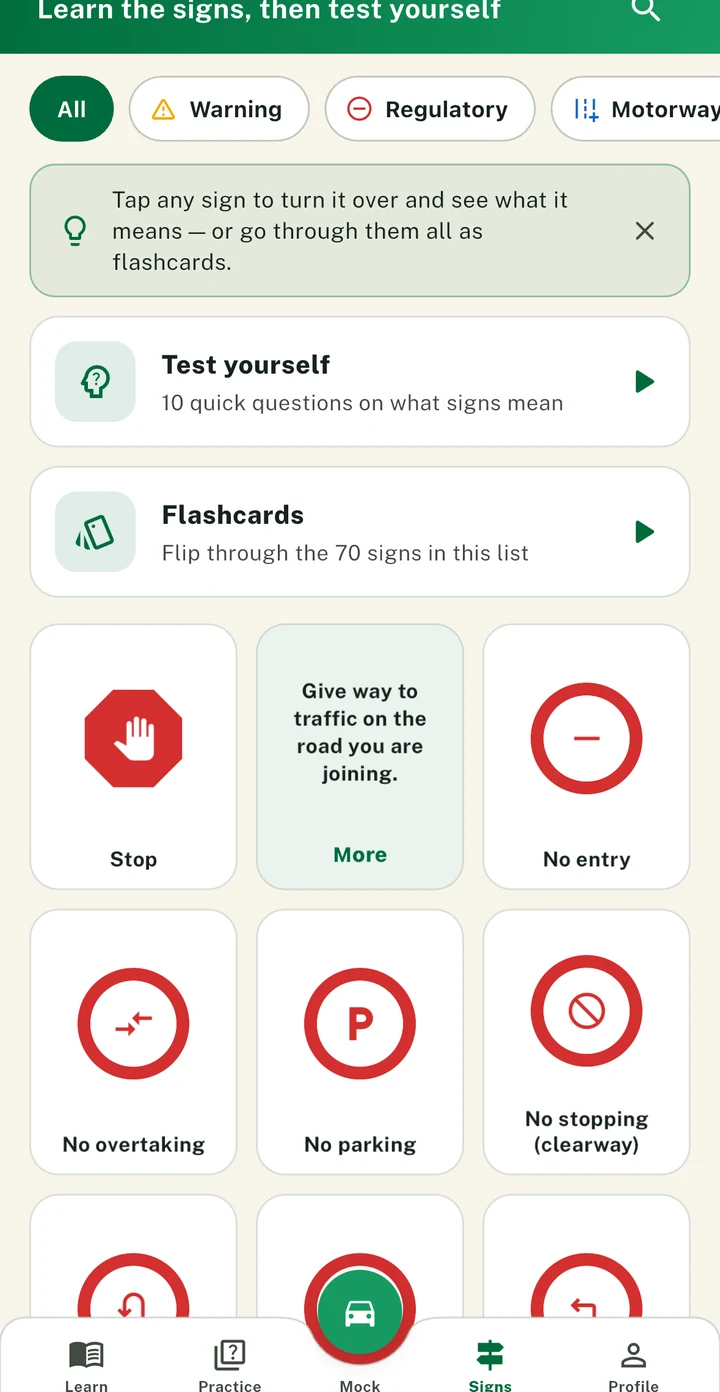
Every sign in your pocket, and three ways to learn them.
Reading a list of signs is not the same as knowing them. The app makes you produce the meaning, which is what the test asks for.
The whole library, and every sign turns over
Tap a sign for what it means and where you meet it — the meaning is the thing the test asks for, not the picture.
Filtered by group: warning, regulatory, motorway, information, roadworks
Search by name when you have seen one on the road and want it now
Works with no signal, which is most of the useful moments
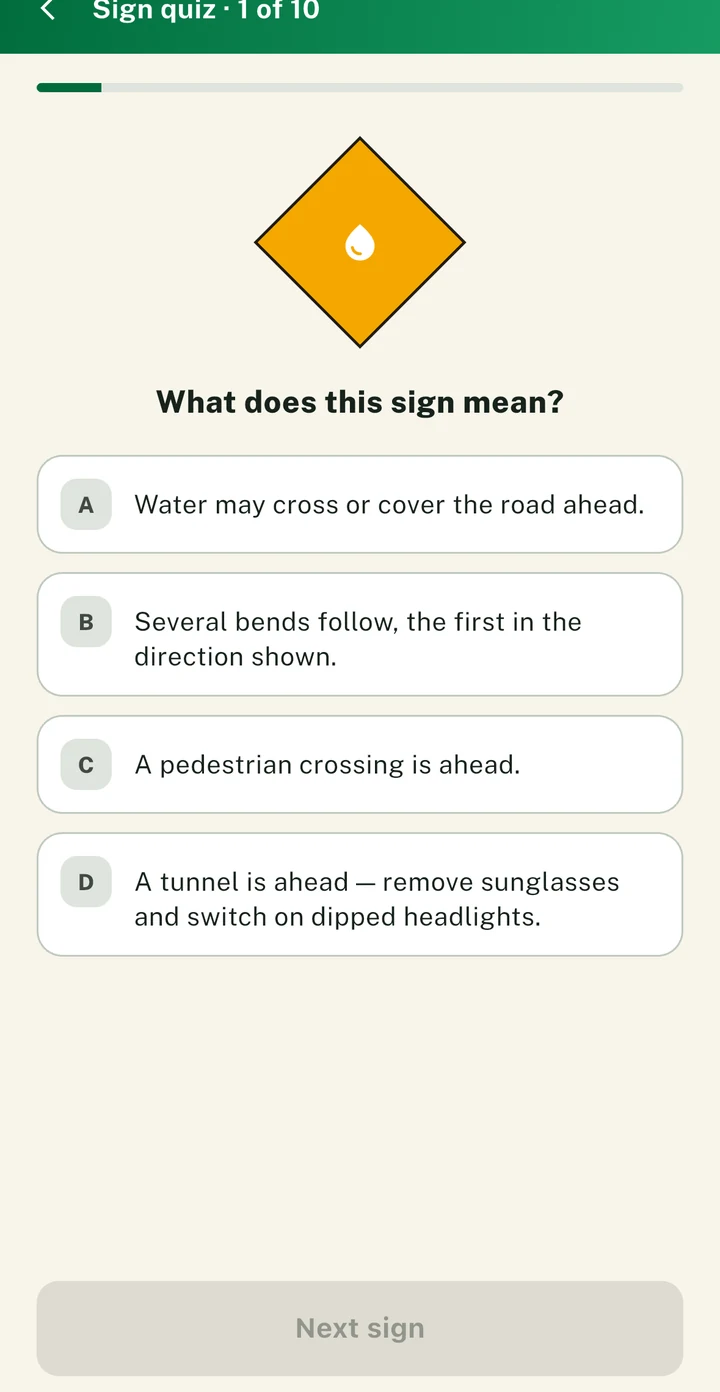
Ten quick questions on what they mean
Recognising a sign and producing its meaning are different skills, and only one of them is tested.
Four meanings, one sign, drawn from the group you are looking at
Never asks you to tell apart two signs that are drawn the same
A score at the end and another ten whenever you want them
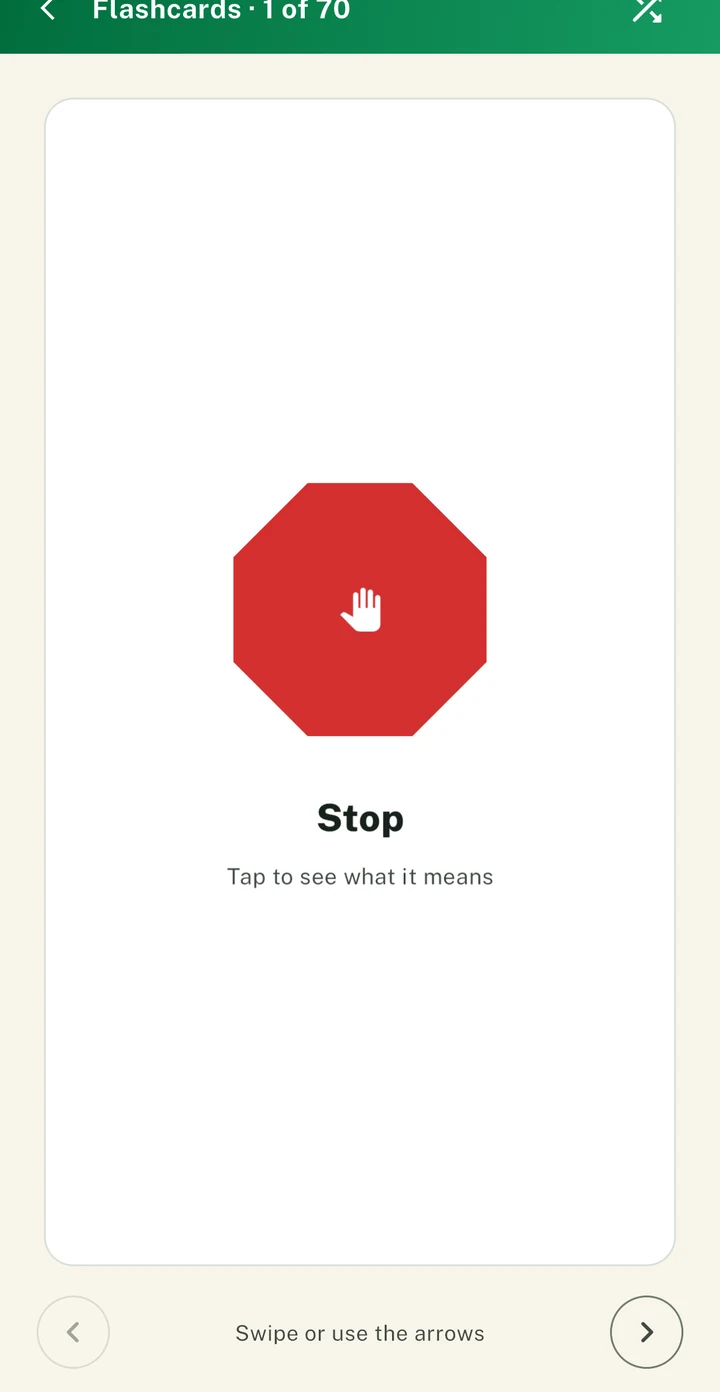
Or flip through them like flashcards
The old way, because it works: sign, guess, turn it over, next.
The full list or just the group you picked
Swipe or use the arrows — one hand, one thumb
Good for the five minutes before you go in